HBS F9P RTK GPS DroneCAN
RTK positioning, directly on DroneCAN.
A compact ZED-F9P receiver with onboard AP_Periph, dual CAN ports and moving-baseline support.
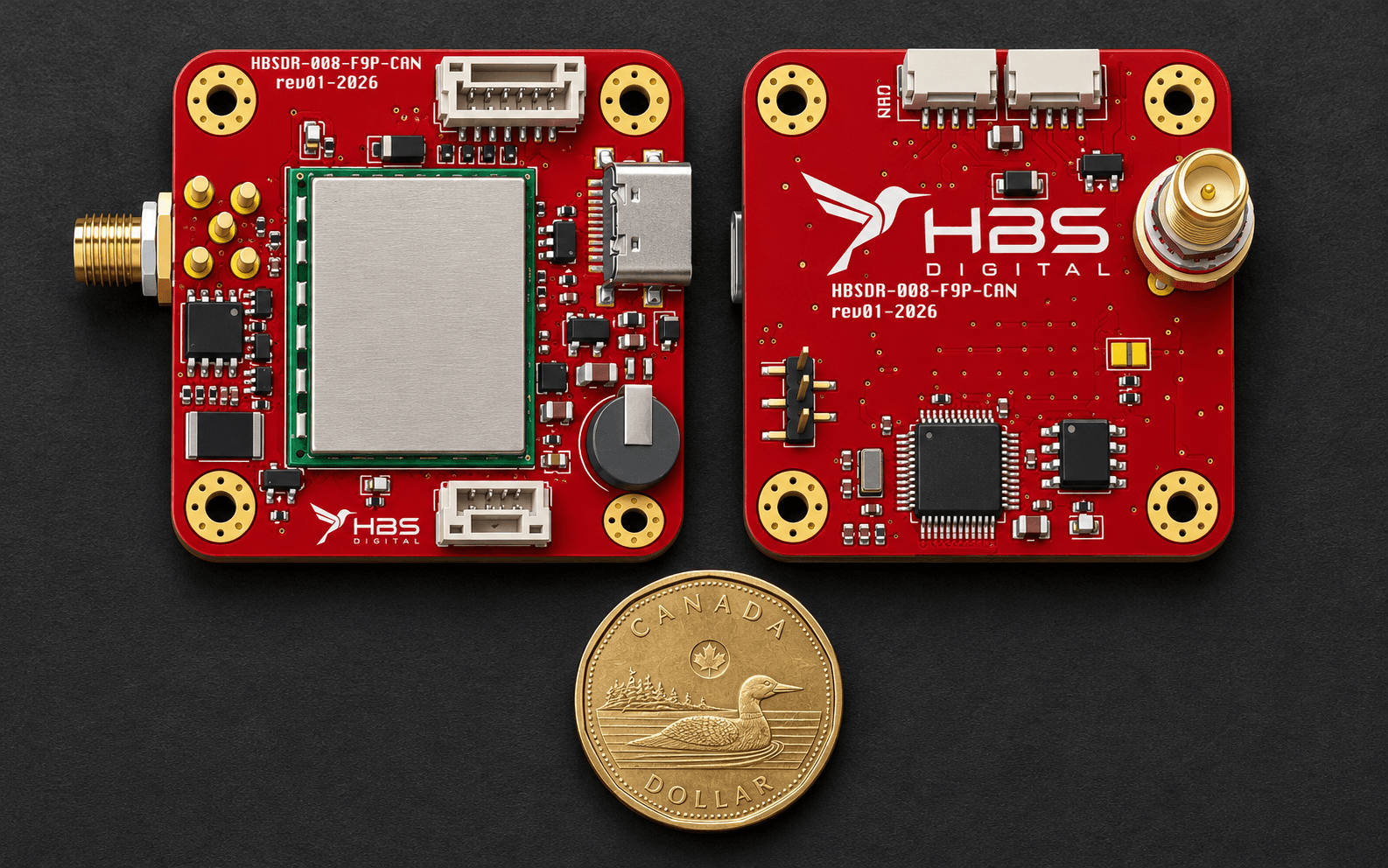
Note 1: Moving-baseline heading requires two matching GPS heads, suitable antennas and a rigid, surveyed antenna baseline.
The HBS F9P RTK GPS DroneCAN pairs a u-blox ZED-F9P-05B with an STM32L431 AP_Periph bridge and CAN transceiver. It connects directly to the aircraft bus, supports a second matching head for moving-baseline heading, and provides SMA antenna and USB-C diagnostic interfaces.
What this enables
- Multiband RTK and moving-baseline support through the ZED-F9P-05B.
- Integrated DroneCAN bridge with dual daisy-chain connectors.
- Compact, approximately 40 × 40 mm footprint.
Best fit for
- DroneCAN-based UAS and robotics platforms.
- Dual-GNSS moving-baseline installations.
- Programs seeking Canadian-designed flight electronics.
Capabilities
ZED-F9P RTK receiver
Multiband GNSS for RTK positioning and moving-baseline applications.
Integrated DroneCAN bridge
STM32L431 AP_Periph and a TCAN332 transceiver connect the receiver to the aircraft bus.
Moving-baseline ready
A dedicated UART2 link connects two matching heads for GPS-for-yaw installations.
Daisy-chain connectivity
Two side-entry JST-GH ports carry power and CAN through the node.
Designed proudly in Canada
Developed by HBS Digital for compact UAS and robotics systems.
Specifications
Everything you need to plan your integration.
Electrical, mechanical and interface details for the HBS F9P RTK GPS DroneCAN.
- GNSS receiver
- u-blox ZED-F9P-05B
- Primary aircraft interface
- DroneCAN
- CAN bridge
- STM32L431 AP_Periph with TCAN332 transceiver
- CAN connectors
- Two 4-pin side-entry JST-GH connectors
- CAN pinout
- 5 V / CAN_H / CAN_L / GND
- Bus termination
- Jumper-selectable split 120 Ω termination
- Antenna connection
- Through-hole SMA interface for an active GNSS antenna
- Moving baseline
- Dedicated 3-pin JST-GH UART2 crossover interface
- Service interface
- USB-C for diagnostics and firmware; external board power required
- Backup supply
- Rechargeable MS621FE cell for receiver backup power
- Board size
- Approximately 40 × 40 mm
- Board construction
- Four-layer PCB
- Origin
- Designed proudly in Canada
Availability
Pre-production
In pre-production. Contact HBS Digital about program availability or integration.
Contact us about HBS F9P RTK GPS DroneCAN